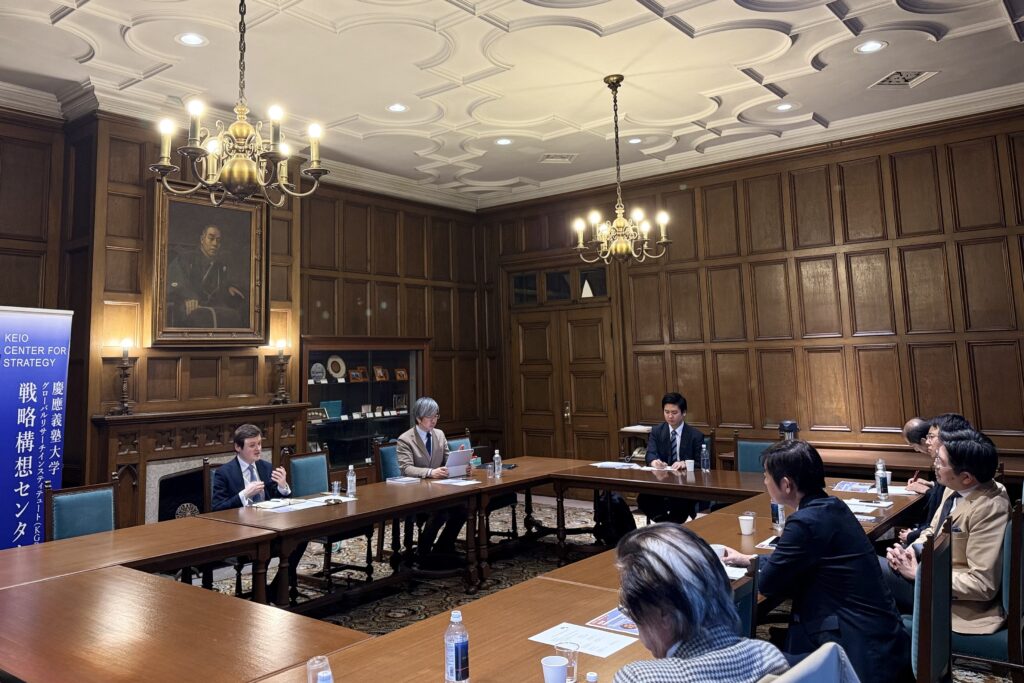
On April 3, 2026, the Keio Center for Strategy (KCS), in collaboration with the Keio Institute for East Asian Studies,hosted its 6th Expert Roundtable (ERT). We welcomed Dr. Edward Howell, Lecturer at the University of Oxford, who delivered a keynote lecture titled “A New Axis of Upheaval? North Korea, Russia, China, Iran—and Why We Should Care.”
The ERT brought together researchers and policy experts, Dr. Howell opened the session by examining the recent trends and evolving cooperative dynamics among the group of states known as “CRINK” (China, Russia, Iran, and North Korea), based on his forthcoming book, A New Axis of Upheaval: North Korea, Russia, China, Iran.
Drawing on the latest geopolitical developments, Dr. Howell analyzed the drivers of alignment among the CRINK nations—ranging from historical precedents to strategic imperatives—and provided a situational analysis and outlook for their respective bilateral relations, characterized by asymmetric bilateralism. Furthermore, he examined the power dynamics within the group, contrasting the substantial material support provided by North Korea—previously viewed as a subordinate state—to an isolated Russia during the war in Ukraine, with the largely rhetorical support offered by China and Russia toward Iran. The discussion also emphasized the need for Japan and South Korea to supplement the role of the United States in deterring North Korea, and the need for Western states to elevate their concerns regarding the strengthening CRINK alignment.
Regarding his primary expertise on North Korea, Dr. Howell highlighted the diminishing international pressure toward denuclearization, North Korea’s internal strength within CRINK as a source of low-cost labor, and its tendency to diversify foreign policy, including engagements with states such as Belarus.
The subsequent Q&A and discussion session featured a vibrant exchange between the speaker and participants on several critical issues: the potential behavior of CRINK nations in the event of a retrenchment of U.S. global engagement; the unique nature of “Cooperation without Coordination” within a group lacking a clear leadership or center of gravity; the significance of often-overlooked cooperation in cyberspace and intelligence; and the unifying role of counter-alignment against the U.S. and its allies.
The dialogue also addressed the inherent vulnerabilities of CRINK, such as internal ideological disparities and the eventual outcome of the war in Ukraine. Regarding the conditions for initiating dialogue with Pyongyang, the discussion touched upon North Korea’s shifting priorities—from Korean unification to regime security and the consolidation of its status as a nuclear-armed state—as well as the necessity of distinguishing between interpersonal and interstate relations in the context of engagement between Pyongyang and the Trump administration.
Participants also explored the differing perceptions among CRINK nations regarding the current international order often termed a “New Cold War” and how North Korea capitalizes on this concept. Finally, the session concluded with an analysis suggesting that the strengthening of CRINK is driven by internal logic as much as external pressure. Warning that acknowledging North Korea as a de facto nuclear state and shifting negotiations toward arms control could trigger a chain reaction leading to a withdrawal of U.S. troops from the Korean Peninsula, the discussion underscored the imperative for the U.S, Europe, and East Asian allies to avoid underestimating these actors and to deepen their own strategic cooperation.